
Bring a Birthday Cake to a Restaurant: Ask First
On this page
- Quick answer
- Get permission before ordering the cake
- Confirm fees and included service
- Ask what cake sources are accepted
- Plan allergen communication
- Confirm delivery and storage
- Plan candles, cutting, and serving
- Choose the right timing
- Use an alternative if outside cake is declined
- Food-safety and policy limits
- Call-ahead checklist
- Frequently asked questions
- Evidence and sources
- Next steps
Quick answer
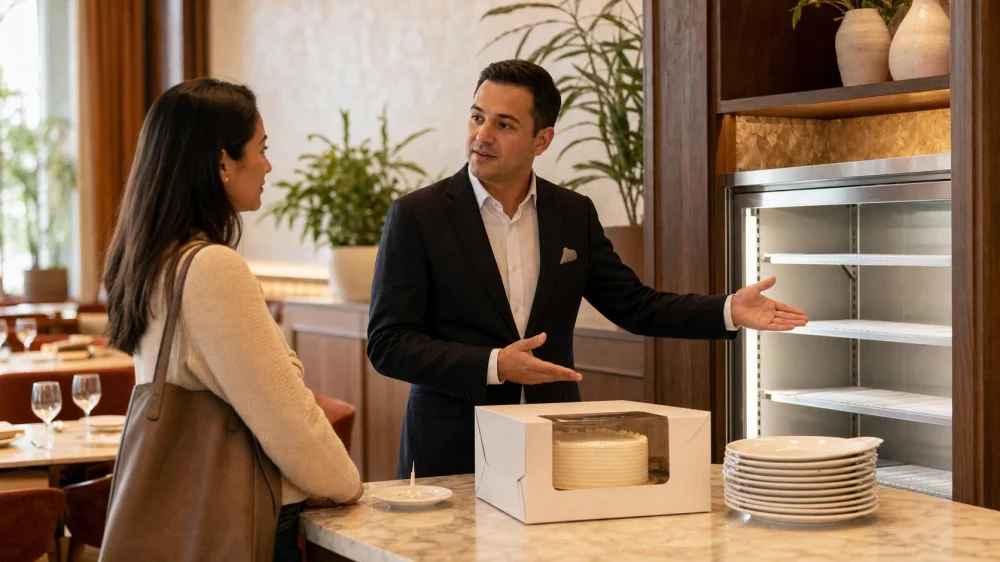
Call the restaurant before you buy or transport a birthday cake. Ask whether outside desserts are allowed, whether the cake must come from a licensed commercial bakery, what cutting or plating fee applies, what storage is available, and which decorations or candles are permitted.
Give the reservation name, date, time, party size, cake size, ingredient or allergen information, delivery plan, and requested serving time. Get the answer in writing when possible. A verbal yes from one employee may not cover refrigeration, open flames, kitchen handling, or a fee on the final bill.
Get permission before ordering the cake
Restaurants balance hospitality with food-safety rules, licensing, insurance, kitchen space, staffing, and their own dessert program. Policies can differ even between locations of the same brand.
Ask a manager or event coordinator:
- May guests bring an outside birthday cake?
- Does it need to come from a licensed bakery in original packaging?
- Are homemade cakes, cupcakes, or ice-cream cakes accepted?
- Does the rule change for a private room or catered event?
- Can staff refrigerate or freeze it?
- Can staff cut and plate it, or must guests handle it?
- Are candles, sparklers, toppers, or knives restricted?
Record the employee’s name and the date of the conversation. Ask for the policy to be added to the reservation notes. If booking through a third-party app, still confirm directly with the location because a reservation note is a request, not approval.

Confirm fees and included service
A cake-cutting or outside-dessert fee may be charged per person, per cake, or as a flat amount. Ask whether tax or gratuity applies and whether children count. Confirm what the fee includes: refrigeration, storage, plates, forks, cutting, garnishes, serving, boxing leftovers, or cleanup.
Compare the total with ordering dessert from the restaurant. An outside cake can still be worthwhile for a design, tradition, or dietary need, but the fee should not surprise the host or guests.
If guests are splitting the bill, decide who will pay the cake fee. Tell the server at the start rather than asking the restaurant to reorganize the bill at the end.
Ask what cake sources are accepted
Some restaurants accept only food from an identifiable commercial source. Others prohibit all outside food or make limited exceptions. Do not remove the bakery label or arrive with an unapproved homemade dessert.
The FDA Food Code is a model used by state and local jurisdictions for restaurant food-safety rules; actual adoption and requirements vary. Restaurants also set policies that may be stricter than the local minimum. A manager’s approval is therefore essential.
Keep the bakery receipt, ingredient statement, and original packaging. Ask the bakery to label the cake flavor, filling, frosting, major allergens, refrigeration needs, and pickup time. Do not ask the restaurant to represent an outside cake as its own product.
Plan allergen communication
An outside cake creates a separate ingredient chain. The restaurant may not know what is in the cake or be able to prevent cross-contact. Ask the bakery for a written ingredient and allergen statement, including ingredients in decorations, fillings, glazes, and toppers.
Tell guests that the dessert is from an outside source. Do not claim it is “allergy-safe” unless the relevant bakery and guest have evaluated the exact risk. A nut-free recipe, for example, does not prove the bakery has no cross-contact.
If a guest has a food allergy, contact the restaurant and bakery well in advance. Let the guest decide whether the available information and preparation environment meet their needs. Consider a sealed, individually labeled alternative from an approved source, but obtain restaurant permission first.
Keep serving utensils separate if different desserts are offered. Do not move a knife from one cake to another or use a garnish plate that has touched an allergen.
Confirm delivery and storage
Ask the bakery how the cake must be held and for how long. Cream, custard, mousse, cheesecake, fresh-fruit, ice-cream, and some frosted cakes can require controlled temperature. A restaurant may have no spare refrigerator or freezer space.
Agree on a delivery window and named recipient. Include the reservation name and event time on the outer box, but do not cover required bakery labels. Keep the cake level, shaded, and protected during transport. Use insulated transport if the bakery recommends it.
Do not leave a temperature-sensitive cake in a parked vehicle or at the host stand for an unspecified time. If storage cannot be confirmed, choose a shelf-stable dessert approved by the bakery and restaurant or order the restaurant’s dessert.
When a delivery service is involved, send the restaurant the courier’s expected time and give the courier a direct contact. Confirm receipt rather than relying only on an app status.
Plan candles, cutting, and serving
Ask whether open flames are permitted. Fire codes, smoke detectors, outdoor wind, and house policy may rule out candles or sparklers. Never bring fireworks-style cake toppers unless the restaurant expressly allows the exact product.
Confirm who supplies the knife, server, plates, forks, matches, and cake stand. A restaurant may not allow a guest’s knife in the dining room. Tell staff about hard decorations, dowels, wires, hidden supports, or non-edible toppers before cutting.
Estimate portions with the bakery. A tall layer cake may require a different cutting plan from a sheet cake. If the restaurant will cut it, ask whether staff can follow the bakery’s portion diagram.
Decide what happens to leftovers. Bring clean bakery boxes only if the restaurant allows guest-provided containers; otherwise ask what packaging is available. Assign one person to take the cake home promptly.
Choose the right timing
Give the server a private cue rather than interrupting table service. A useful plan is “after entrées are cleared, before checks are printed.” If there are speeches, gifts, or photos, give an approximate duration so the table is not occupied far beyond the reservation.
For surprise events, tell staff who the guest of honor is and who may authorize changes. Avoid elaborate deception that confuses staff about delivery or payment. A simple reservation note and one host contact is enough.
Arrive early if you must inspect the cake, but do not open it in a service area without permission. If the restaurant is running behind, prioritize safe storage over a precise reveal time.
Use an alternative if outside cake is declined
A no is not necessarily poor service. Ask whether the kitchen can provide:
- a whole cake ordered in advance;
- a plated dessert with a candle;
- individual desserts arranged for the table;
- a written birthday message on a plate;
- a preordered dessert tasting;
- a take-home celebration cake for after the meal.
You can also schedule cake at home before or after dinner. This removes storage and cutting constraints while keeping the restaurant meal relaxed.
Food-safety and policy limits
This article provides general planning information. Retail food rules are enforced mainly by state, local, and tribal authorities, and the FDA Food Code is a model rather than a single nationwide restaurant law. Restaurant licensing, insurance, fire rules, and alcohol rules can add restrictions.
Follow the bakery’s storage instructions and the restaurant’s policy. People who are pregnant, older, very young, immunocompromised, or managing severe allergies may need more cautious choices. When temperature control or ingredient information is uncertain, do not serve the item.
Call-ahead checklist
- Reservation name, date, time, and party size
- Outside-dessert permission in writing
- Accepted bakery source and original label
- Cake size, portions, and storage needs
- Cutting fee, tax, gratuity, and included service
- Ingredient and allergen statement
- Delivery time and named recipient
- Candle and decoration policy
- Knife, plates, serving, and leftover plan
- One host contact for decisions and payment
Frequently asked questions
Can a restaurant charge a cake-cutting fee?
Restaurants may set an outside-dessert fee where permitted. Ask the amount and what it covers before the event.
Can I bring a homemade birthday cake?
Only if the restaurant explicitly permits it and local rules allow it. Many locations require a commercial source or prohibit outside food.
Will the restaurant refrigerate an ice-cream cake?
Do not assume it can. Freezer space may be unavailable. Confirm capacity, delivery timing, and responsibility before ordering.
Who is responsible for allergy information?
The bakery should provide accurate ingredient information, the host should communicate that the cake is external, and each guest must evaluate personal risk. The restaurant may be unable to verify or control the outside cake.
Evidence and sources
Next steps
Before contacting a bakery, call the restaurant and use the checklist. Send a short confirmation email with the cake source, size, storage need, fee, delivery time, and serving plan.
Then place the bakery order using the restaurant’s approved conditions. Save both confirmations with the reservation and share the final plan with one backup host.
 Casa Birria NYC (Food Truck)4.0 (159 reviews)
 Clairmont Diner4.0 (757 reviews)
 Chouette4.0 (212 reviews)
 The Parlour at The Barclay4.0 (81 reviews)
 El Vaquero Mexican Restaurant4.0 (1732 reviews)
 RUTA 55 RESTAURANT4.0 (143 reviews)
 Best Seafood Boils You Must Try This Year
 Best Chinese Dumpling Spots With Authentic Recipes
 Snack Ideas Every Food Lover Should Know
 Best Sushi Spots with Local Sashimi Picks
 Best Family-Friendly Restaurants for Weekend Dining
 Best Mediterranean Salads Worth Trying Everywhere | Brunch & Snack Chat