
Brunch Egg Orders: Match Doneness, Texture, and Travel
Egg terminology looks simple until a table expects different yolks, whites, textures, and serving styles. A useful order describes both the cooking method and the result you want, then accounts for restaurant policy, food-safety needs, and whether the dish will be eaten immediately or carried home.
Quick answer
Name the style, then describe the desired yolk and white: for example, “over medium, with the white fully set and the yolk thick but not hard.” Ask whether the kitchen accepts doneness requests for that dish and whether it uses shell eggs or a pasteurized egg product. People at higher risk of foodborne illness should choose eggs cooked until both yolk and white are firm, or foods made with pasteurized eggs, following their clinician’s advice. For takeout, expect carryover cooking and travel to change texture.

Compare common egg styles
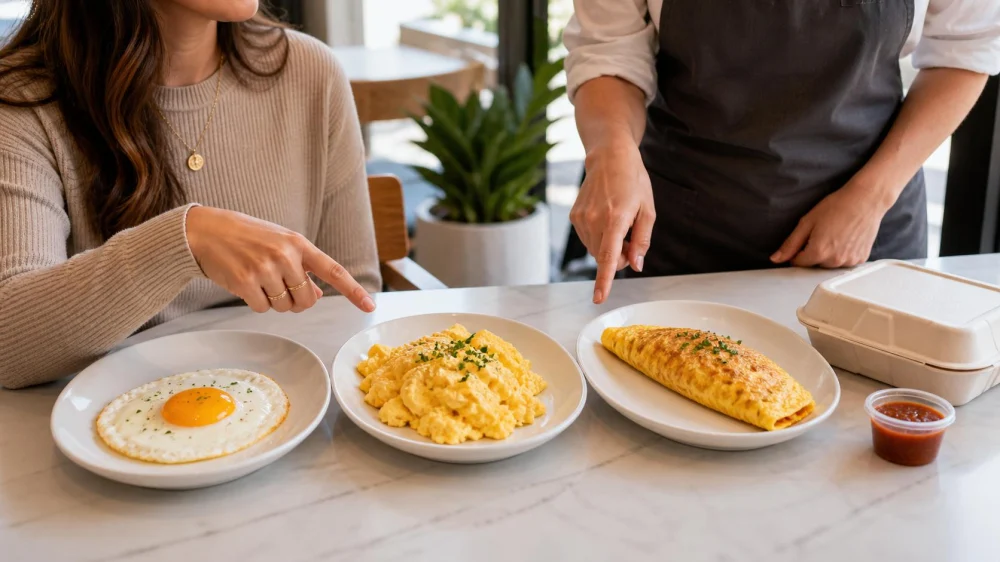
Sunny-side up is cooked without flipping. The white sets against the pan while the upper yolk remains visible. Results vary depending on whether the pan is covered or basted.
Over easy, medium, and hard describe flipped eggs, but restaurants do not share one exact timing standard. “Easy” generally leaves a runny yolk, “medium” thickens it, and “hard” cooks it through. State the texture that matters rather than relying only on the label.
Poached eggs cook out of the shell in water. Time affects both yolk and white. Soft-, medium-, or hard-cooked shell eggs have different centers, although local terms vary.
Scrambled eggs can be soft and creamy, firm and dry, or somewhere between. Added dairy, butter, cheese, vegetables, and holding time change the texture. An omelet adds choices about browning, folding, fillings, and whether the interior stays moist.
Ask precise ordering questions
- Choose the cooking style shown on the menu.
- Describe whether the white should be fully set.
- Describe the yolk as runny, jammy, thick, or fully firm.
- Ask whether that result is available for the selected dish.
- State allergies and medically necessary restrictions clearly.
- Confirm substitutions, added charges, and side choices.
Use plain language and keep the request short. “Poached medium, with a set white and thick yolk” is easier to relay than several conflicting modifiers. If the kitchen uses a house standard, ask what it looks like.
Egg preparation can differ from one visit to the next because egg size, starting temperature, equipment, and service volume vary. A texture request is a preference, not a laboratory specification.
Match the egg to the dish
A runny yolk can become a sauce for toast, potatoes, grains, or vegetables, but it may soak bread during a long meal. A firmer yolk travels more neatly and can suit a sandwich. Soft scrambled eggs contrast with crisp toast, while firmer curds can hold up better inside a burrito.
For eggs Benedict or another sauced dish, ask whether the poached egg doneness can be adjusted without changing the rest. For a breakfast sandwich, consider whether cheese, sauce, tomato, or a juicy filling already adds moisture. For a salad or grain bowl, a jammy or fully cooked egg may distribute more evenly.
Group orders benefit from labels. Attach each diner’s name to a complete combination—egg style, side, toast, and allergy note—rather than sending a separate list of modifiers.
Consider food-safety needs
Raw and undercooked eggs can contain harmful bacteria. The U.S. Food and Drug Administration advises cooking eggs until both yolk and white are firm and cooking egg dishes thoroughly. Recipes served raw or undercooked should use pasteurized eggs or egg products.
Young children, older adults, pregnant people, and people with weakened immune systems face higher risk from foodborne illness. They should avoid raw or undercooked eggs and seek individualized guidance from a healthcare professional when needed. A menu advisory does not remove the risk.
Ask the restaurant whether a pasteurized option is available, especially for lightly cooked eggs, hollandaise, house mayonnaise, mousse, or another preparation that may contain uncooked egg. Do not assume “farm fresh,” free-range, organic, local, or a particular shell color changes the need for safe handling.
Plan for takeout and delivery
Eggs continue to change while held in a hot container. Steam can firm a yolk, soften toast, and make scrambled eggs weep. Choose a slightly more travel-tolerant style, request sauces separately, and keep toast or crisp potatoes away from wet components when the restaurant can package them separately.
Pick up at the stated time, keep containers level, and go directly to the destination. Do not leave egg dishes in a vehicle while completing errands. Refrigerate perishable leftovers within two hours, or within one hour when the surrounding temperature exceeds 90°F.
For reheating, transfer food to suitable cookware and heat leftovers thoroughly. Texture may change, so reheat only the portion you plan to eat. Do not try to restore a runny center by only warming the outside.
Handle an order that is not right
Before eating, compare the dish with the request. If the egg is substantially less cooked than ordered, an allergy request appears wrong, or the dish seems unsafe, stop and tell staff. Describe the observable issue calmly—such as “the white is still translucent” or “this contains the cheese I asked to omit.”
Ask the restaurant to remake, replace, or remove the item according to its policy. Do not ask the kitchen merely to scrape off an allergen. For delivery, photograph the sealed package and item, keep the receipt, and contact the restaurant or platform promptly.
Do not taste questionable food to decide whether it is safe. Seek medical advice for concerning symptoms; call emergency services for trouble breathing, facial or throat swelling, collapse, or another severe allergic reaction.
Frequently asked questions
Is “over medium” identical everywhere?
No. Use the term plus a description of the white and yolk texture you expect.
Which egg style travels best?
Fully set fried eggs, firm scrambled eggs, and omelets often tolerate travel better than runny or delicate eggs, but packaging and trip time matter.
Does a brown egg cook differently?
Shell color does not define doneness or food safety. Cooking method, egg size, temperature, and time affect the result.
Can I request pasteurized eggs?
You can ask, but availability and preparation vary. Confirm directly with the restaurant before relying on it.
Next steps
Choose the dish, name the egg style, and describe the exact white and yolk texture. Confirm whether the kitchen can make that result, communicate allergies directly, and choose fully cooked or pasteurized options when safety needs require them. For takeout, separate wet components and travel directly.
Review the FDA’s egg safety guidance for official cooking, storage, and higher-risk-group advice.

 Le Pain Quotidien4.0 (723 reviews)
 La Mexicana Taqueria (Food Truck)4.0 (16 reviews)
 Blanquita4.0 (54 reviews)
 Taqueria sol de Arcelia4.0 (23 reviews)
 Ben's Pizzeria3.0 (651 reviews)
 Ellen's Stardust Diner4.0 (22379 reviews)
 How to Take Restaurant Leftovers Home Safely
 Best Lebanese Sweets and Desserts to Try | Brunch & Snack Chat
 Local Eats That Will Make You Fall in Love with Food | Best Spots in the U.S. to Satisfy Your Taste Buds
 Why Dining Experiences Matter for an Unforgettable Experience
 Best Ramen Restaurants Serving Specialty Broths | Brunch & Snack Chat
 Seafood Places: Tips, Trends, and Secrets