
Restaurant Leftovers: Pack, Transport, and Reheat Safely
On this page
Quick answer
Ask for containers before perishable food has sat out too long, divide large portions into shallow containers, and refrigerate promptly. USDA guidance says to refrigerate perishable leftovers within two hours, or within one hour when exposed to temperatures above 90°F. Transport them directly in a clean insulated bag with cold sources when needed, then reheat leftovers to 165°F measured with a food thermometer.
Decide before the meal lingers
The food-safety clock does not restart when a server brings a box. Consider how long the meal has been at room temperature, whether it was kept hot or cold, the temperature outdoors or in the car, and how long the trip to refrigeration will take.
If perishable food has exceeded the recommended time limit or its history is uncertain, discarding it is safer than relying on smell, appearance, or later reheating. People at higher risk of foodborne illness should follow current guidance from their healthcare professional and FoodSafety.gov.
Ask for a box early enough to pack calmly, but do not leave the closed container on the table through a long conversation. Keep raw or undercooked take-home ingredients separate from ready-to-eat leftovers.

Pack for quick cooling
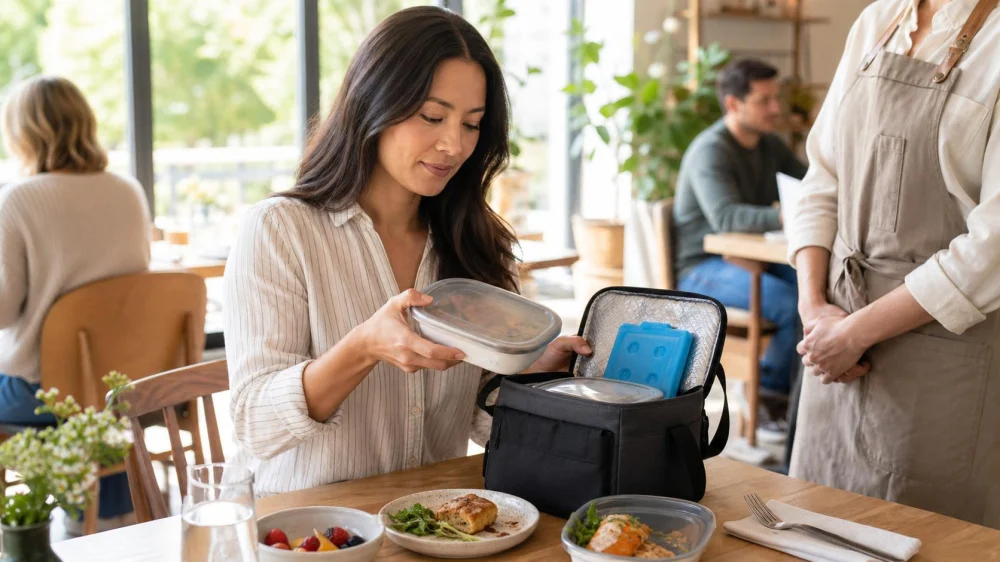
Divide a large entrée, dense casserole, rice dish, or shared platter into smaller portions and shallow containers when practical. Close containers securely and keep sauces or liquids upright. Separate foods that will be reheated differently so one item does not remain cold while another overcooks.
Use clean containers intended for food. If the restaurant container is damaged, leaking, or unsuitable for reheating, transfer the food at home using clean utensils. Do not place a container in an oven or microwave unless it is specifically approved for that use.
Label the package at home with the food and refrigeration date. This prevents guessing after several unlabeled restaurant boxes accumulate.
Control the trip home
Go directly to a refrigerator or freezer rather than leaving leftovers in a parked car, on a sunny seat, or during errands. For a longer journey, use a clean insulated bag with adequate cold sources and keep it closed. An insulated bag slows temperature change but does not make an unlimited trip safe.
Keep containers away from dirty reusable bags, chemicals, pet items, and raw groceries. Stabilise them so lids do not open. When arriving home, refrigerate immediately rather than leaving the bag by the door.
Store and reheat
Keep the refrigerator at 40°F or below. USDA guidance generally gives refrigerated leftovers a three-to-four-day window; freeze them sooner if you will not use them in time. When in doubt about a specific food or storage event, use current official guidance.
Reheat leftovers to 165°F and check several places with a food thermometer, especially after microwave heating. Cover and rotate food for more even heating, allow steam to escape safely, and bring sauces, soups, and gravies to a rolling boil as USDA advises.
Reheat only the portion you plan to eat when practical. Do not taste food to decide whether it is safe, and do not rely on reheating to correct excessive time at unsafe temperatures.
Leftover checklist
- Time away from temperature control estimated.
- Outdoor, car, and travel conditions considered.
- Large portions divided into shallow containers.
- Lids secure and liquids upright.
- Cold transport used when needed.
- Food refrigerated promptly on arrival.
- Container and date labelled.
- Refrigerator at 40°F or below.
- Reheated food checked to 165°F.
Limitations and warning signs
This guide is general US food-safety information, not medical advice. Ingredients, preparation, prior holding, transport, appliances, and individual health risks vary. Discard food with an uncertain time or temperature history. For suspected foodborne illness, severe symptoms, dehydration, pregnancy, immune compromise, very young or older age, contact an appropriate healthcare professional promptly.
FAQ
Can I leave leftovers in the car while shopping?
That adds uncontrolled time and temperature exposure. Transport perishable food directly to refrigeration with suitable cold control when needed.
Does smell prove leftovers are safe?
No. Harmful organisms may not change smell, taste, or appearance.
Can I reheat food in the restaurant container?
Only if the container is approved for that appliance and remains intact. Transfer to a suitable clean dish when uncertain.
How hot should leftovers be?
USDA recommends 165°F measured with a food thermometer, checked in several places for even heating.
Evidence notes
USDA Food Safety and Inspection Service guidance on leftovers and food safety supports the two-hour rule, the one-hour limit above 90°F, shallow containers, cold storage, and reheating to 165°F. FoodSafety.gov's eating-out guidance applies the same prompt-refrigeration approach to restaurant leftovers.
Next steps
Place a small insulated bag and cold pack in your car before the next restaurant visit. At the table, decide early whether the trip home fits the official time guidance, then label and refrigerate the food immediately on arrival.



 Ostioneria Aranda's4.0 (1372 reviews)
 Noodles and Company4.0 (437 reviews)
 Buffalo Wild Wings 'GO'4.0 (221 reviews)
 Sapps4.0 (108 reviews)
 Margarita's Cocina Mexicana4.0 (105 reviews)
 Cadillac Bar4.0 (2830 reviews)
 Why Seafood Places Locals Swear By Across the United States
 Best Thai Street Food Inspired Eateries in America: Where Flavor Meets Culture
 Snack Ideas Every Food Lover Should Know
 Best Mexican Restaurants With Regional Desserts
 How to Eat Like a Local in New Orleans’ Best Restaurants | Brunch & Snack Chat
 Why Best Restaurants Where Every Bite Feels Like Heaven | Ultimate Guide