
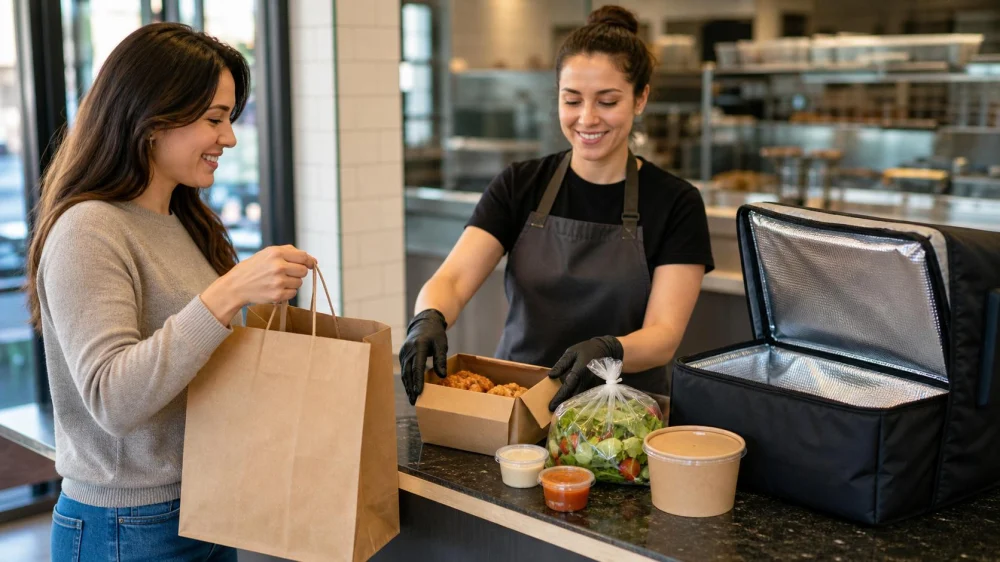
Takeout Packaging: Choose, Carry, and Reheat Safely
Good takeout should arrive in the condition the kitchen intended: hot foods hot, cold foods cold, crisp items reasonably crisp, and sauces contained. Packaging, travel time, and what you do after pickup all affect quality and food safety. A short handoff plan helps you order the right containers, carry them without spills, and store or reheat leftovers promptly.
Quick answer
Choose dishes that tolerate the expected trip, request sauces and wet garnishes separately, and keep raw or chilled items apart from hot food. At pickup, confirm the name, count, closures, and special requests without opening sealed food. Keep the bag upright, go directly to the destination, and refrigerate perishables within two hours—or within one hour when the surrounding temperature is above 90°F. Reheat leftovers thoroughly in a microwave-safe or oven-safe vessel rather than assuming every takeout container can be heated.

Plan the order for travel
Start with the actual journey. A five-minute walk and a forty-minute drive create different challenges. Note traffic, parking, weather, the number of bags, and whether you can keep food level. If the trip will be long, ask the restaurant which dishes travel best.
Fried foods, toasted bread, delicate greens, frozen desserts, and runny eggs can change quickly. Braises, grain bowls, baked dishes, and foods with sauce packed separately often travel more predictably. This is a quality choice, not a guarantee: use the restaurant’s advice for its menu.
Tell the restaurant about allergies before ordering and ask how takeout requests are handled. A note in an app is useful but may not replace a direct conversation. If cross-contact avoidance is essential, confirm whether the restaurant can meet the requirement.

Match packaging to the food
Vented containers allow steam to escape and can help fried or roasted food stay less soggy. Tight, leak-resistant containers suit soups, curries, sauces, and other liquids. Divided containers keep wet components away from crisp or dry ones, while small sealed cups help control dressings and condiments.
Ask for cold salad, sushi, dairy sauces, or desserts to be bagged separately from very hot entrées. Keep raw foods separate from ready-to-eat dishes. Do not request an improvised package that the restaurant does not use or approve.
Container appearance does not reveal whether it is safe for a microwave, conventional oven, freezer, or dishwasher. Look for clear instructions or transfer the food to known cookware. Metal, foil, some plastics, coated paper, and containers with hidden fasteners can be unsafe in a microwave.
Inspect the order at pickup
- Match the receipt or order name before leaving.
- Count entrées, side containers, beverages, and separate bags.
- Check that lids are seated and liquid containers remain upright.
- Confirm labeled special requests and allergy notes with staff.
- Ask for missing utensils or condiments only if they are needed.
- Place cold and hot packages in separate carriers when practical.
Do not break a tamper-evident seal merely to inspect presentation. If the bag leaks, feels unstable, or has a crushed container, ask staff to repackage it before transport.
Carry hot, cold, and crisp items
Use a flat vehicle floor or stable cargo surface rather than a soft, sloped seat. Brace bags so they cannot tip during braking, but do not crush lids. Keep food away from pets, cleaning products, sports gear, and other contamination sources.
An insulated carrier can slow temperature change, but it does not reset the safety clock or make an extended errand safe. Go directly to the destination. In hot weather, use air conditioning and keep food out of a parked car. For a longer planned trip, use separate appropriate hot and cold carriers and ask the restaurant for handling guidance.
For crisp food, keep any designed vents open and avoid wrapping the whole container in a way that traps steam. Never open or adjust packages while driving.
Unpack and store promptly
Wash hands, clear a clean surface, and unpack immediately. Serve what will be eaten now. Divide large amounts of leftovers into shallow containers so they cool more efficiently, label them with the date, and refrigerate promptly.
The U.S. Department of Agriculture advises refrigerating perishable food within two hours, or within one hour when the temperature is above 90°F. If food has been left out beyond those limits, discard it; smell and appearance cannot reliably show whether harmful bacteria have grown.
Keep the refrigerator at 40°F or below and avoid overfilling it so cold air can circulate. When a restaurant provides specific storage instructions, follow them. Foods containing raw or lightly cooked animal ingredients may need special caution.
Reheat for safety and quality
Transfer leftovers to suitable cookware. For a microwave, arrange food evenly, add moisture when appropriate, cover with a vent, rotate or stir, and allow standing time. For an oven or skillet, use a method that suits the food while preventing scorching.
USDA guidance recommends reheating leftovers to 165°F as measured with a food thermometer. Check several spots in thick or mixed dishes. Bring sauces, soups, and gravies to a rolling boil when reheating. Do not rely solely on steam, bubbling edges, or a hot plate.
Reheat only the portion you intend to eat. Some quality losses are unavoidable: lettuce, cold garnishes, and delicate sauces are usually better removed before heating. Follow product-specific directions for restaurant meal kits or partially cooked items.
Reduce packaging waste thoughtfully
Decline utensils, napkins, condiment packets, and bags you will not use. Consolidation can reduce material, but hot and cold foods, allergens, and liquids may still need separation. Do not ask staff to compromise safe packaging.
Local recycling and composting rules vary. Empty containers, remove food residue as required, and sort only materials accepted by the local program. A recycling symbol does not guarantee curbside acceptance.
Reusable containers can work only when a restaurant explicitly participates in a system designed for them. Do not hand an unapproved personal container across a food-service counter.
Frequently asked questions
Should I loosen the lid on fried food?
Use the container as designed and ask the restaurant. A vent can release steam, but opening a package can increase spill or contamination risk.
Can I microwave the original container?
Only when it is clearly marked or the restaurant confirms it is microwave-safe. Otherwise transfer the food to known microwave-safe cookware.
Is an insulated bag enough for several errands?
No. It can slow heat transfer but does not replace prompt delivery or temperature control.
Can I judge leftovers by smell?
No. Food can be unsafe without an unusual odor, taste, or appearance. Use time, temperature, and storage history.
Next steps
Before ordering, estimate the travel time and choose food that fits it. Request separate sauces and hot or cold grouping, inspect the bag at pickup, travel directly, and unpack promptly. Store leftovers in shallow containers and reheat them with suitable cookware and a thermometer.
For official handling details, see the USDA leftovers and food safety guidance.
 Seoul BAP4.0 (374 reviews)
 Bronx NY Pizza4.0 (109 reviews)
 Birria Landia UWS4.0 (103 reviews)
 Majorelle4.0 (255 reviews)
 New Hing Wong3.0 (76 reviews)
 Kennedy Chicken and Burgers3.0 (210 reviews)
 Best Restaurants That Will Change Your Life: Transformative Dining Experiences
 Your Ultimate Guide to Casual Cafes: Best Spots and Must-Try Menus
 Exploring Foodie Guides Perfect for Date Night: A Culinary Adventure
 Why Dessert Spots Are Essential for an Unforgettable Experience
 Why Ice Cream Shops That Are Worth Traveling For | Top Destinations
 Brunch Group Order: Confirm Names, Allergies, and Split Checks