
BYOB Restaurant Checklist: Corkage, Service, and Safety
On this page
- Quick answer
- Confirm BYOB is lawful and permitted
- Questions to ask the restaurant
- Choose a suitable bottle
- Transport it legally and safely
- Handle arrival and service smoothly
- Understand corkage and gratuity
- Track serving size and alcohol content
- Plan a sober ride home
- Use considerate BYOB etiquette
- Health and legal limits
- Before-you-go checklist
- Frequently asked questions
- Evidence and sources
- Next steps
Quick answer
Call the exact restaurant location before bringing alcohol. Ask whether BYOB is legal and allowed there, which beverages are accepted, whether a corkage fee applies, whether every guest must show identification, what glassware or chilling service is available, and whether opened bottles may leave the premises.
State and local alcohol laws vary widely, and restaurant policy can be stricter. “BYOB” does not mean a guest may serve anyone underage, an intoxicated person, or themselves without limits. Keep the bottle sealed during transport as required, plan a sober ride, and follow staff instructions.
Confirm BYOB is lawful and permitted
Alcohol rules are not uniform across the United States. The federal Alcohol and Tobacco Tax and Trade Bureau maintains a directory of state and local alcohol authorities and explains that jurisdictions may impose requirements in addition to federal rules.
A restaurant without a liquor license is not automatically BYOB. Local law may prohibit outside alcohol, require a particular license, limit beverage types, or allow the practice only in specified establishments. A licensed restaurant may also choose not to permit outside bottles.
Verify with the restaurant and, when needed, the relevant state or local alcohol authority. Do not rely on an old review, a general chain policy, or a social-media photo. Ask again for special events, private rooms, outdoor seating, and holiday service.
Questions to ask the restaurant
- Do you currently permit guests to bring alcohol?
- Are wine, beer, cider, or spirits treated differently?
- Is there a corkage or service fee per bottle or per table?
- Is there a bottle-size or quantity limit?
- May we bring a label that appears on your wine list?
- Will staff open and pour, or do guests serve themselves?
- Are wine glasses, an ice bucket, or decanting available?
- Does everyone who may drink need physical identification?
- What happens to an unfinished opened bottle?
- Does the policy differ for our party size or room?
Add the answer to the reservation notes. If a fee is important to the decision, request written confirmation. Staff may refuse service at the restaurant based on identification, intoxication, safety, or license obligations even when BYOB was approved in advance.
Choose a suitable bottle
Bring something you genuinely want to drink with the meal rather than the largest or strongest bottle. Consider the restaurant’s cuisine, number of adult drinkers, and whether the bottle needs chilling or decanting.
A standard 750-milliliter wine bottle contains about five 5-ounce servings, but actual pours and alcohol concentration vary. One shared bottle may be enough for a small table; bringing multiple bottles can create pressure to finish them.
Check whether the restaurant restricts large-format bottles, homemade alcohol, damaged seals, growlers, fortified wine, or spirits. Keep the original label intact. Do not transfer alcohol to an unmarked bottle.
If a guest does not drink, bring no-alcohol pressure to the table. Ask the restaurant about its nonalcoholic pairings rather than assuming an outside zero-proof beverage is permitted.
Transport it legally and safely
Keep the bottle sealed and secured upright in a bag or carrier. Protect it from heat and breakage. Do not chill glass so aggressively that it becomes slippery or damaged.
Open-container rules vary by state and vehicle location. A conservative plan is to transport sealed alcohol in the trunk or another area not readily accessible to the driver or passengers, then confirm local law. Rideshare, public transit, walking, and cycling also have local rules and safety concerns.
For leftovers, ask the restaurant before opening whether it can legally reseal the bottle and whether you may remove it. If permitted, follow the required packaging and transport method. Never carry an open container into another venue without authorization.
Handle arrival and service smoothly
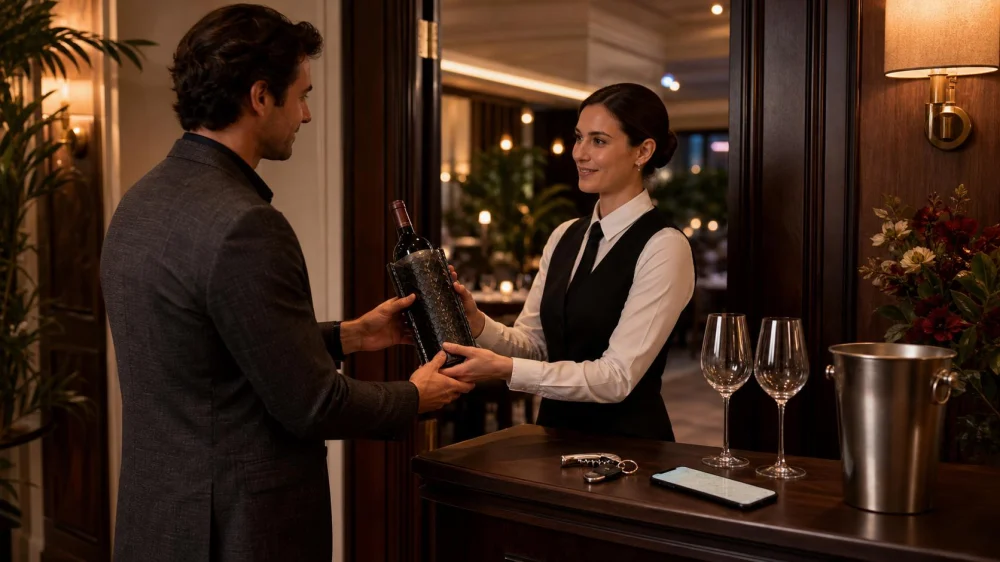
Tell the host that the reservation includes an approved BYOB note. Hand the sealed bottle to the server rather than placing it in a service station, refrigerator, or ice bucket yourself.
Let staff inspect identification and manage opening if required. Ask before using your own corkscrew, aerator, decanter, or glassware. A damaged cork or flawed bottle does not obligate the restaurant to replace it.
If the bottle needs chilling, arrive with enough time or use a safe insulated carrier. Do not bring loose ice that can leak through the dining room. If a wine contains sediment, carry it upright and avoid unnecessary shaking.
When the restaurant sells alcohol, do not secretly refill a house bottle or disguise the source. Clear handling protects the establishment’s license and avoids billing confusion.
Understand corkage and gratuity
Corkage can cover staff time, glassware, opening, chilling, decanting, washing, and the revenue opportunity displaced by an outside bottle. Ask whether the amount is per bottle opened, not merely brought, and whether tax or automatic gratuity is added.
Include wine service when calculating a tip where customary. A waived corkage fee does not erase the labor of opening, pouring, refreshing glasses, and cleaning. Do not pressure staff to waive a published fee.
If the restaurant offers a “buy one, waive one” arrangement or limits waived bottles, confirm the exact terms. A promotion shown online may have dates, table-size requirements, or excluded labels.
Track serving size and alcohol content
Alcohol by volume varies. A strong wine, craft beer, or generous pour can contain more alcohol than it appears. NIAAA defines one U.S. standard drink as 0.6 fluid ounces, or 14 grams, of pure alcohol. Examples include approximately 5 fluid ounces of 12% wine, 12 ounces of 5% beer, or 1.5 ounces of 40% distilled spirits.
Standard-drink comparisons are educational estimates, not a guarantee of impairment level. Body size, food, medications, health, drinking speed, and other factors affect risk. Eating or drinking coffee does not make an impaired person safe to drive.
Pour slowly, keep water available, and allow guests to decline. Do not turn an unfinished bottle into a challenge. Staff can stop alcohol service, and guests should respect that decision.
Plan a sober ride home
Decide transportation before opening the bottle. Use a designated driver who consumes no alcohol, a taxi or rideshare, public transit, or nearby lodging. Confirm pickup access and closing time.
Do not assign the driver based on who “feels fine” after dinner. If the original plan fails, leave the vehicle and arrange another ride. Keep the restaurant address and a charged phone available.
Never serve alcohol to a person under the legal drinking age. Pregnancy, certain health conditions, recovery from alcohol use disorder, and interactions with medications are reasons someone may avoid alcohol entirely. Respect a no without questions.
Use considerate BYOB etiquette
Choose a bottle that is not already prominent on the current list unless the restaurant says otherwise. Bring a reasonable quantity, order food, accept the corkage fee, and include the service in gratuity.
Do not offer alcohol to neighboring tables or staff. Keep tasting orderly and avoid turning the table into an unapproved sales event or club meeting. Ask before photographing staff handling a special bottle.
If you offer the server or sommelier a taste, understand that workplace policy may prohibit acceptance. A polite offer is optional; pressure is not.
Health and legal limits
This article is general information, not legal or medical advice. Alcohol licensing, possession, service, open-container, age, and transportation laws vary by jurisdiction and can change. Consult the restaurant and official state or local alcohol authority.
Alcohol carries health risks. Some people should not drink at all, including anyone who is underage, pregnant or may be pregnant, driving, operating equipment, taking interacting medication, unable to control intake, or advised not to drink by a healthcare professional. If alcohol use is causing concern, seek qualified medical support.
Before-you-go checklist
- Direct approval from the exact restaurant location
- Allowed beverage type, size, and quantity
- Corkage, tax, gratuity, and waiver terms
- Identification requirements
- Glassware, chilling, and opening plan
- Sealed, labeled, safely transported bottle
- Plan for an unfinished bottle
- Named sober driver or alternate ride
- Water and nonalcoholic choices for the table
Frequently asked questions
Does BYOB mean no corkage fee?
No. A restaurant can permit outside alcohol and still charge for opening and service. Confirm the fee before arrival.
Can I bring spirits to a BYOB restaurant?
Not necessarily. Local law and restaurant policy may allow wine or beer but prohibit spirits. Ask about the exact beverage.
Can I take home an opened bottle?
Only if applicable law and restaurant procedure allow it. Ask about resealing and transport before the bottle is opened.
How many servings are in a bottle of wine?
A 750-milliliter bottle is roughly five 5-ounce pours. Actual pours and alcohol by volume vary, so track the label and amount served.
Evidence and sources
- TTB: Directory of state and local alcohol beverage authorities
- NIAAA: What is a standard drink?
- NIAAA: Understanding alcohol drinking patterns
Next steps
Call the restaurant with the exact bottle type and party size. Record permission, corkage, service, identification, and leftover-bottle rules in the reservation.
Then choose the bottle, arrange a sober ride, and bring it sealed. At the restaurant, hand it to staff and let their service and safety rules lead.
 McDonald's3.0 (2624 reviews)
 A1 Adyar Ananda Bhavan4.0 (1107 reviews)
 Tosokchon NYC4.0 (599 reviews)
 Halal New York Gyro4.0 (216 reviews)
 Empire Steak House West4.0 (2869 reviews)
 Soju Haus4.0 (901 reviews)
 How Foodie Guides Can Make You Fall in Love with Food
 Vegan Restaurants That Are Worth the Wait: A Guide to the Best Vegan Dining Experiences
 Best Brunch Spots: From Street Eats to Fine Dining
 Best Sushi Spots for Sake Pairing Nights: A Complete Guide
 Romantic Dining Every Food Lover Should Know | Brunch & Snack Chat
 : How to Find Dining Experiences That Will Surprise You - Brunch & Snack Chat