
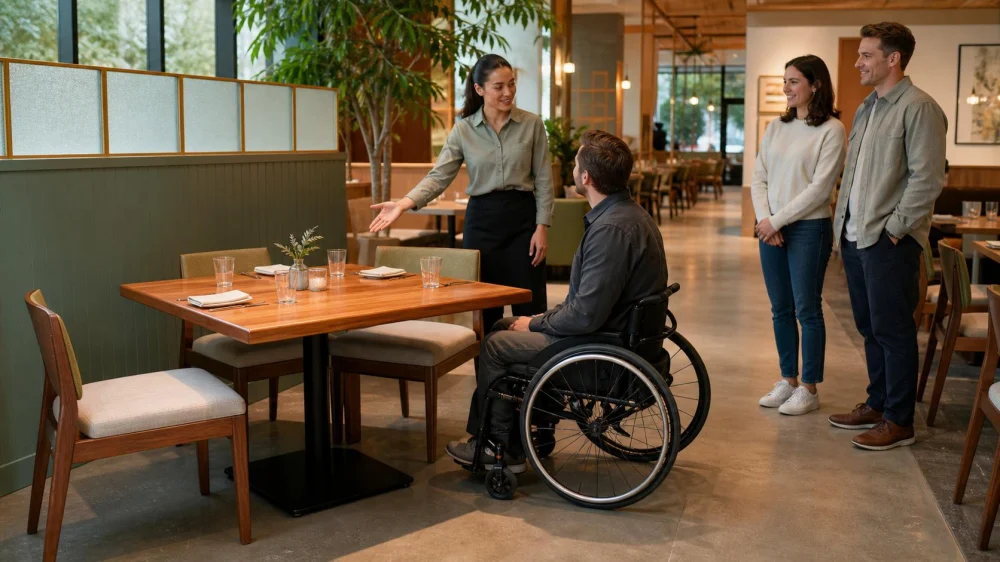
Wheelchair-Friendly Restaurant Seating: What to Ask
On this page
Quick answer
Before visiting an unfamiliar restaurant with a wheelchair or mobility device, ask about the complete route from arrival to the table, table type and clearance, aisle space when chairs are occupied, restroom access, service counters, and any steps or heavy doors. Describe the feature you need rather than asking only “Is it accessible?” Record the reservation note and reconfirm if the layout may change.
This U.S. planning guide helps diners ask useful questions; it does not certify a restaurant, measure legal compliance, or replace an individual's judgment about transfer, mobility, assistance, or emergency needs.

Ask about the full route
An accessible table is useful only if a diner can reach it. Ask staff to think through the route in order:
- parking, passenger drop-off, rideshare point, sidewalk, or transit stop;
- curb cut, ramp, slope, surface, and weather exposure;
- entrance threshold, door width, door weight, and vestibule;
- host stand and waiting area;
- aisles to the dining table;
- buffet, beverage station, payment counter, patio, and restroom if needed;
- the return route and exit.
Ask whether the route stays clear at the intended time. Deliveries, strollers, stored high chairs, crowded waiting guests, outdoor heaters, and movable tables can narrow an otherwise usable path.
If a lift or elevator is part of the route, ask whether it is operating and available without a special key or long delay. Do not rely solely on an old photo or review; equipment and layouts change.

Check the table and seating area
Describe the mobility device and seating preference. Some diners remain in a wheelchair; others transfer to a restaurant chair and need safe storage for the device. Never assume one approach.
- Is the table a standard-height table rather than a high-top?
- Does it have open knee and toe space, or does a centre pedestal block approach?
- Can a chair be removed without placing the wheelchair in an aisle?
- Is there room to turn and leave when surrounding tables are occupied?
- Can the group sit together rather than splitting the diner from companions?
- Is the requested seating indoors or outdoors, and is the route to it accessible?
A photo can clarify table legs and layout, but it cannot confirm measurements, current furniture spacing, slope, or the diner's fit. Ask staff to verify the actual table they plan to hold.
Ask about service points and restrooms
For counter service, ask whether ordering, pickup, condiments, beverages, trays, and payment are reachable. If a station is not usable, ask what equivalent table service or assistance is available.
If a restroom is important to the visit, ask specific questions: Is it on the same accessible route? Are there steps? Does the door and stall accommodate the device? Are grab bars and clear space available? Is the room currently open and free of stored supplies?
Dietary, sensory, hearing, vision, and service-animal needs may coexist with mobility needs. Discuss each required feature separately so one broad note does not hide a critical detail.
Make a clear reservation note
A useful note names the practical setup without disclosing unnecessary medical information. For example: “One guest uses a power wheelchair and will remain in it. Please reserve a standard-height table on a step-free route with one chair removed and clear aisle space.”
Also record:
- date, time, party size, and reservation name;
- indoor or outdoor preference and weather alternative;
- mobility-device type and approximate space needs;
- whether transfer or device storage is requested;
- restroom or counter-service needs;
- service animal, if relevant;
- staff member or channel that confirmed the setup.
Reconfirm shortly before a busy service, event, or patio visit. Ask the restaurant to keep the note with the reservation rather than relying on one employee's memory.
Arrival and dining checklist
- Use the planned arrival point and check for temporary barriers before unloading.
- Tell the host which reservation note applies.
- Inspect the route and table from the diner's perspective before the full group settles.
- Ask staff to move chairs or small movable obstacles rather than doing unsafe lifting.
- Keep mobility devices, bags, and service animals out of travel aisles while maintaining the diner's access.
- Confirm a clear exit route before the restaurant becomes busier.
- Address a mismatch promptly and describe the needed feature again.
If the planned table does not work, ask for an equivalent accessible option and allow the person using the mobility device to decide whether the alternative meets their needs.
Important limits and rights notes
The Americans with Disabilities Act applies to many restaurants and addresses accessible routes, dining surfaces, service areas, and reasonable access. Actual duties can depend on building age, alterations, barrier-removal feasibility, and other legal facts. A customer's phone checklist cannot determine compliance.
Do not treat a directory badge, map icon, crowd review, or one employee's “yes” as a guarantee. Features can be measured incorrectly, blocked, broken, or described from a walking person's perspective.
If access is denied or a serious barrier remains, document factual details without obstructing service or filming other diners. Resources may include management, the U.S. Department of Justice ADA information line, a local disability-rights organization, or qualified legal advice. Deadlines and remedies vary.
Frequently asked questions
Is a ramp enough to call a restaurant accessible?
No single feature answers the whole question. The route, doors, tables, aisles, service points, restroom, and current obstructions can all affect use.
Should I give the restaurant wheelchair dimensions?
Approximate width, length, turning, and table-approach needs can help staff choose a setup, especially for a larger power chair or scooter. Share only what is useful.
Can staff require a diner to transfer to a chair?
Do not assume. Explain that the guest will remain in the wheelchair and ask for a table with a chair removed. Seek official ADA guidance or legal advice for a disputed situation.
What about a service animal?
Discuss the animal and seating route. Under federal ADA guidance, service animals generally may accompany their handlers in restaurants, but they are not seated or fed at the table. State rules may add protections.
Can a restaurant move tables to make room?
Movable furniture may allow a workable setup, but staff should preserve safe aisles and service routes. Ask the restaurant to plan the arrangement before arrival.
Sources and evidence notes
This checklist reflects federal accessibility concepts without deciding compliance. The U.S. Department of Justice's ADA primer for small businesses explains accessible routes to dining areas, service points, and public restrooms, as well as dispersed accessible tables and maneuvering space. Current federal, state, local, and case-specific requirements should be checked through official or qualified sources.
Next steps
Write the route, table, restroom, service, and device features that matter for this visit. Call the restaurant at a non-rush time, ask each question specifically, and place the confirmed setup in the reservation note. Recheck temporary barriers on arrival and let the diner decide whether the actual arrangement works.




 Flour Modern Pasta Bar3.0 (90 reviews)
 Jersey Mike's Subs4.0 (142 reviews)
 Los Gutierritoz taqueria4.0 (25 reviews)
 Dave's Hot Chicken (Coming Soon)4.0 (12 reviews)
 Triple 83.0 (85 reviews)
 Lilli and Loo4.0 (847 reviews)
 Top Indian Street Food Dishes You Should Order at Restaurants
 Best Chinese Tea Houses With Traditional Snacks | Brunch & Snack Chat
 Why Ice Cream Shops That Are Worth Traveling For
 Top 13 Dessert Spots You Must Try This Year
 Hidden Neighborhood Restaurants You Need to Try This Month
 Your Ultimate Guide to Dining Experiences: From Casual to Fine Dining