
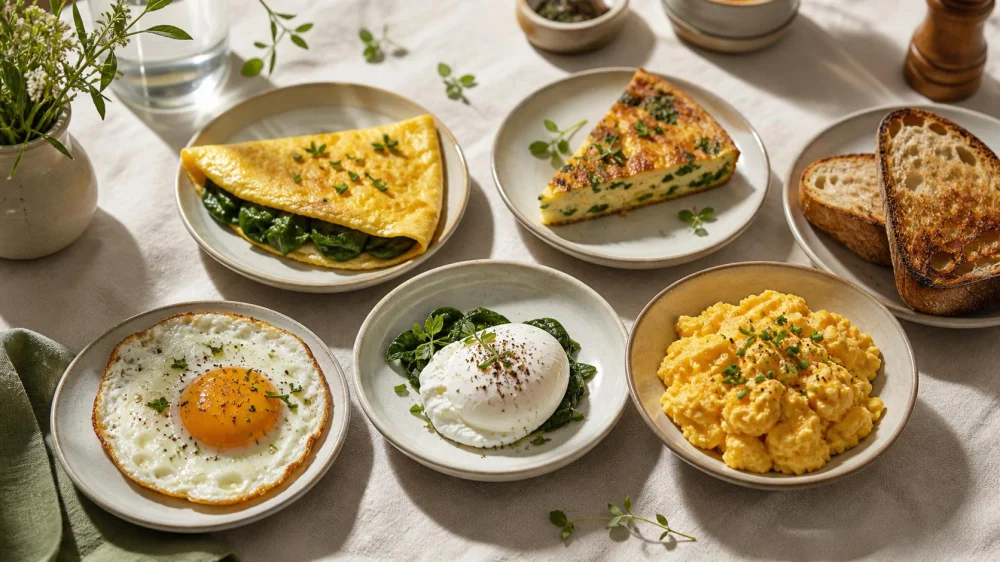
Brunch Egg Styles: Choose Texture, Shape, and Doneness
On this page
Quick answer
Choose fried or poached eggs when you want distinct whites and yolks, scrambled eggs for a soft or firm curd, an omelet for folded fillings, and a frittata for a thicker, sliceable egg dish. Then specify doneness rather than assuming every restaurant uses the same terms. Ask how sauces and mixed dishes are prepared if egg allergy or undercooked egg is a concern. For the lowest food-safety risk, request eggs with firm whites and yolks.
This US dining guide explains common menu language; a restaurant’s recipe may differ. People at higher risk for severe foodborne illness—including young children, older adults, pregnant people, and people with weakened immune systems—should follow current FDA advice and ask questions before ordering undercooked eggs.
Start with three choices
Before comparing names, decide what you want from the plate:
- Texture: separate white and yolk, creamy curds, a folded egg layer, or a firm slice.
- Doneness: flowing, jammy, softly set, or firm.
- Role: the main item, a topping, a sandwich filling, or a base for vegetables, meat, cheese, and sauce.
These choices make ordering clearer than asking for “a normal egg.” If the menu gives no description, ask the server how the kitchen usually prepares that item and whether changes are possible.
Fried eggs
Fried eggs cook directly on a hot surface with fat. “Sunny-side up” usually means the egg is cooked on one side, leaving the yolk visible. “Over” styles are flipped, with the following word describing the intended yolk doneness.
- Over easy: a short cook after flipping, generally leaving a flowing yolk.
- Over medium: a longer cook, often producing a partly set or jammy yolk.
- Over hard: cooked until the yolk is firm.
Kitchens interpret easy and medium differently. If the exact texture matters, say “firm white and fully set yolk” or explain that you prefer no runny egg.
Poached eggs
A poached egg is cooked out of its shell in hot water. It usually has a tender white wrapped around the yolk and little browned edge. Poached eggs often appear on eggs Benedict, toast, grain bowls, and salads because the yolk can act like a sauce.
Poached does not automatically mean runny, although that is a common presentation. Ask whether the kitchen can cook the yolk firmer. On a Benedict-style dish, also ask about hollandaise ingredients and preparation if egg allergy or undercooked egg is a concern.
Scrambled eggs
Scrambled eggs are beaten before or during cooking, creating curds rather than separate whites and yolks. Soft scrambling usually means smaller, moister curds; a firmer scramble cooks longer and may have larger or drier curds.
Restaurants may add butter, cream, milk, cheese, seasoning, or pre-mixed liquid egg product. Ask before ordering if dairy, seasoning, or ingredient cross-contact matters. “Egg whites only” changes the richness and texture and may carry an extra charge depending on the menu.
Omelets and frittatas
An omelet is generally cooked as a relatively thin egg layer and folded around or over fillings. It is best when you want ingredients contained in one portion and can choose additions such as vegetables, herbs, meat, or cheese.
A frittata is a thicker, open-faced egg dish with ingredients distributed through it. It is often finished in an oven and served in a wedge. Compared with a folded omelet, it is usually firmer and more sliceable. Quiche differs because it is a custard-like egg filling commonly baked in pastry.
Ask whether vegetables or meats are pre-cooked, which cheeses or sauces are included, and whether the dish can be modified. Removing one visible filling may not remove an allergen already mixed into the eggs.
Baked and boiled eggs
Baked eggs may arrive in a small dish with tomatoes, greens, cream, cheese, or other ingredients. The heat retained by the dish can continue cooking the eggs after they leave the oven. Shakshuka-style dishes commonly poach or bake eggs in seasoned tomato sauce, though recipes vary.
Boiled eggs range from soft-cooked, with a fluid or jammy center, to hard-cooked, with a firm yolk. They work well on toast, salads, snack plates, and breakfast bowls. If the menu uses “jammy,” ask what the kitchen means because the degree of setting is not standardized.
Match the style to the dish
- Toast or breakfast sandwich: fried, folded scrambled, or omelet-style eggs are easy to layer; a firm yolk is less messy for takeout.
- Eggs Benedict: poached eggs supply a tender texture, while hollandaise adds richness.
- Grain bowl or hash: fried or poached eggs keep the yolk separate; scrambled eggs distribute through the dish.
- Vegetable-forward plate: a frittata or omelet can hold several additions in one portion.
- Long trip or takeaway: fully cooked scrambled, folded, or hard-cooked eggs generally travel more neatly than a runny yolk.
Also consider the sauce, bread, potatoes, meat, cheese, and vegetables around the egg. A rich egg preparation may feel more balanced with fresh or acidic sides, while a plain preparation can carry a stronger sauce.
Ask about doneness and food safety
Raw and undercooked shell eggs can carry foodborne-illness risk. The FDA and USDA advise consumers to cook eggs until both whites and yolks are firm and to cook egg-containing foods thoroughly. The FDA also advises using pasteurized eggs or egg products for foods served raw or undercooked.
Restaurant food-code requirements and kitchen methods vary. Ask whether a dish contains a raw or undercooked egg, whether pasteurized egg is available, and whether the menu carries a consumer advisory. If you have an egg allergy, explain that clearly; doneness preferences and allergy controls are different questions, and no restaurant can guarantee zero cross-contact unless it has a process that supports that claim.
Ordering checklist
- Choose the texture: separate, scrambled, folded, or sliceable.
- State the desired yolk and white doneness clearly.
- Ask what butter, dairy, cheese, sauce, and seasoning are included.
- Confirm whether a substitution changes the price or sides.
- Discuss allergy controls separately from preference.
- Request firm whites and yolks when minimizing undercooked-egg risk.
- For takeout, choose a texture that travels and reheats well.
Frequently asked questions
Are poached eggs always runny?
No, but a soft or flowing yolk is common. Ask how the restaurant serves them and request a firmer yolk if that is your preference.
What is the difference between an omelet and a frittata?
An omelet is usually a thinner egg layer folded with fillings, while a frittata is thicker, open-faced, and often finished in an oven. Restaurant recipes and serving styles vary.
Does “over hard” mean the egg is fully cooked?
It generally signals a firm yolk, but doneness terms are not perfectly standardized. State that you want both yolk and white fully firm if that is important.
Can an egg-free plate still have egg cross-contact?
Yes. Shared grills, utensils, fryers, batters, sauces, and prep areas may matter. Tell the restaurant about an allergy and ask what controls it can use before ordering.
Sources and evidence notes
The US Food and Drug Administration’s egg-safety guidance advises cooking yolks and whites until firm and using pasteurized eggs for recipes served raw or undercooked. The USDA Food Safety and Inspection Service provides similar consumer guidance and describes common cooking methods. Texture descriptions in this article reflect common culinary usage, not regulated doneness definitions.
Conclusion and next steps
Start by choosing texture, doneness, and the egg’s role on the plate. Use fried or poached eggs for distinct components, scrambled eggs for curds, an omelet for folded fillings, and a frittata for a firm slice. Ask how the restaurant interprets menu terms, state allergy concerns plainly, and request firm yolks and whites when you want the lower-risk option described by federal food-safety guidance.

 Malecon4.0 (1765 reviews)
 El Acapulco Mexican Restaurant4.0 (1184 reviews)
 Papi’s Cheese steaks And More4.0 (157 reviews)
 The Ellington4.0 (788 reviews)
 OSAKA TON KATSU5.0 (154 reviews)
 Cardinal Pizza4.0 (414 reviews)
 Best Steakhouse for Unforgettable Dining Experiences
 Why Dining Experiences That Are Worth Traveling For are a Must-Have
 Your Ultimate Guide to Food Trends
 Why Restaurant Reviews Where Every Bite Feels Like Heaven Matter for Food Lovers
 Best Lebanese Restaurants With Signature Mezze
 Best Mediterranean Brunch Spots With Healthy Bowls in 2026