
Brunch Waffle Guide: Crispness, Shape, and Toppings
On this page
Quick answer
Choose a brunch waffle by its texture and topping load. Deep-pocket Belgian-style waffles hold syrup and fruit but can soften under heavy toppings; thinner waffles offer more crisp edge. Ask whether toppings are served hot, cold, or on the side, and confirm batter, cooking-surface, and garnish allergens before ordering.
Compare waffle styles
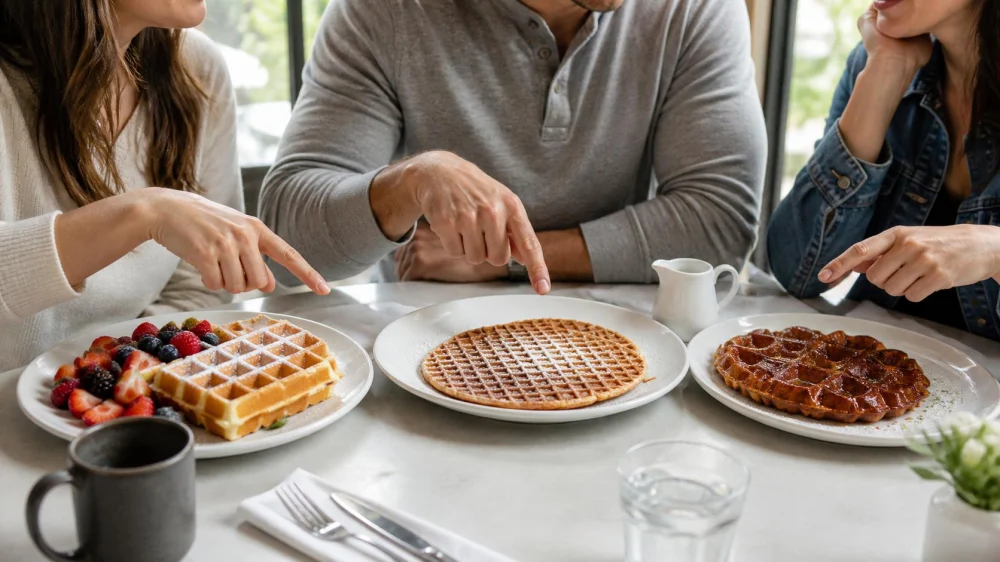
Restaurants use “Belgian,” “classic,” “Liege,” and house-style labels differently. Belgian-style waffles are often thick with deep pockets. American-style waffles may be thinner with a more even crispness. Liege-style waffles generally use a richer yeast dough with caramelized sugar and can be denser.
Shape—round, square, or segmented—changes presentation more than flavor. Ask about batter and texture instead of choosing only by the menu name.
Choose the texture
- Crisp outside, tender inside: a balanced choice for syrup and butter.
- Thin and crisp: holds shape under lighter toppings.
- Soft and cake-like: absorbs sauces quickly.
- Chewy and caramelized: richer and often sweet enough with minimal topping.
Ask for sauces on the side if crispness matters. Steam trapped beneath another waffle or a closed takeout lid will soften the surface.
Build a sweet waffle
Start with one main flavor: fresh fruit, warm compote, chocolate, nut spread, caramel, or maple syrup. Add contrast with yogurt, whipped cream, nuts, seeds, or a small crisp garnish.
Too many wet toppings can turn the waffle soggy and hide the batter's flavor. Request syrup, sauce, and cream separately when you want control.
Build a savory waffle
Savory waffles may include herbs, cheese, cornmeal, or spices and can be paired with eggs, vegetables, chicken, smoked fish, or gravy. Ask how strongly the batter is seasoned and whether sweet syrup is included.
For chicken and waffles, decide whether you prefer bone-in or boneless chicken, spicy or mild seasoning, and sauce on top or side. Poultry should be cooked to a safe internal temperature; appearance alone cannot establish doneness.
Balance toppings
- Pick the waffle texture.
- Choose one main topping.
- Add one contrasting texture.
- Put the wettest sauce on the side.
- Check whether a side dish makes the portion too large.
- Share or pack extras within food-safety limits.
Ask about allergens
Waffle batter commonly contains wheat, milk, and egg. Nuts, peanuts, soy, sesame, and other allergens may appear in flavorings and toppings. Waffle irons, utensils, fryers, and prep surfaces may be shared.
Name the exact allergen and ask about batter, cooking equipment, sprays, butter, garnish, and cross-contact. “Gluten-free” or “vegan” does not answer every allergy question. People at risk of severe reactions should follow their medical plan.
Ordering checklist
- Is the waffle thin, thick, yeast-raised, or caramelized?
- Can it be made extra crisp without burning?
- Which toppings arrive on the waffle?
- Can syrup, gravy, or cream come on the side?
- What allergens and shared equipment are involved?
- Is the portion suitable for one person?
- How will a takeout waffle be vented and packed?
Handle leftovers
Refrigerate waffles and perishable toppings within applicable time limits, generally within two hours or one hour when temperatures exceed 90°F (32°C). Keep sauces and cream separate when possible.
Reheat a plain waffle in an oven or toaster according to the restaurant's advice for better crispness. Reheat poultry and other leftovers to the safe temperature recommended by U.S. food-safety authorities. Discard food with an uncertain time-and-temperature history.
Important limitations
This is general dining and food-safety information. Recipes, portion sizes, allergens, equipment, and storage differ by restaurant. Staff and written ingredient information are the primary sources for a specific order.
Sources and evidence notes
- U.S. Food and Drug Administration: major food allergen and restaurant food-safety information.
- USDA Food Safety and Inspection Service: poultry temperatures, leftover storage, and reheating guidance.
- The restaurant: primary source for batter, cooking surfaces, cross-contact, portion, and packaging.
- Professional culinary references: waffle styles, batter structure, and moisture effects on crispness.
Frequently asked questions
Are Belgian waffles always yeast-raised?
No. Restaurants may use baking powder or another formula. Ask how the house version is made.
How do I keep toppings from making the waffle soggy?
Order sauces and juicy fruit on the side, then add small amounts as you eat.
Is a savory waffle less sweet?
Often, but not always. Some use the same sweet batter beneath savory toppings, so ask.
Can waffles be allergy-safe on a shared iron?
Cross-contact may occur. Explain the allergy and ask the restaurant whether its equipment and process can meet your needs.
Conclusion
A satisfying brunch waffle begins with texture, not the longest topping list. Choose thin or thick, decide how much crispness matters, build around one main flavor, and keep wet sauces separate. Confirm allergens and shared equipment, then refrigerate perishable leftovers promptly.

 Connie's4.0 (1901 reviews)
 Mofongos1.0 (7 reviews)
 Hwa Yuan Szechuan4.0 (1096 reviews)
 Jack in the Box3.0 (253 reviews)
 Taco Bell4.0 (572 reviews)
 Vista Hermosa4.0 (719 reviews)
 How to Plan a Foodie Road Trip Through the South
 From Street Eats to Fine Dining: Unique Snack Ideas for Every Occasion
 Dining Experiences That Will Make You Fall in Love with Food
 Ultimate Guide to Finding the Best Brunch Spots in Every Major US City
 How to Find Snack Ideas That Are Worth the Wait
 Why Steakhouse That Are Totally Instagrammable Are Worth the Visit